The Challenge
When you find a critical point at x = a where f'(a) = 0, your first instinct is to use the second derivative test. But what happens when f''(a) = 0 as well? The second derivative test becomes inconclusive.
Don't Panic! There are several reliable alternative methods to determine whether x = a is a maximum, minimum, or neither. You don't always need higher derivatives.
Method 1: The First Derivative Test
This is often the most practical and intuitive method. Instead of looking at f''(a), we examine the sign of f'(x) on both sides of x = a.
First Derivative Test Algorithm:
1. Find f'(x) and verify f'(a) = 0
2. Choose a test point just left of a (call it a - h, where h is small)
3. Choose a test point just right of a (call it a + h)
4. Evaluate f'(a - h) and f'(a + h)
Decision Rules:
• If f' changes from NEGATIVE to POSITIVE → LOCAL MINIMUM
• If f' changes from POSITIVE to NEGATIVE → LOCAL MAXIMUM
• If f' has the SAME SIGN on both sides → INFLECTION POINT
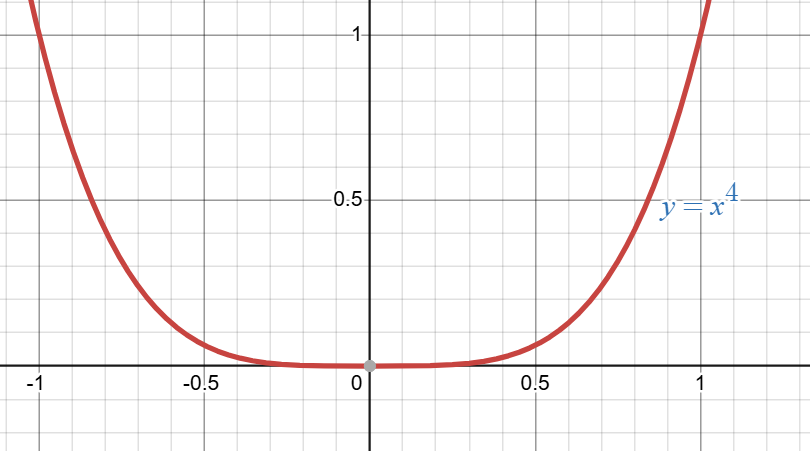
EXAMPLE: f(x) = x⁴ at x = 0
Step 1: f'(x) = 4x³, so f'(0) = 0 ✓
Step 2: f''(x) = 12x², so f''(0) = 0 (inconclusive!)
Step 3: Use the first derivative test:
• Test x = -0.1: f'(-0.1) = 4(-0.1)³ = -0.004 < 0 (negative)
• Test x = +0.1: f'(+0.1) = 4(+0.1)³ = +0.004 > 0 (positive)
Conclusion: f' changes from negative to positive, so x = 0 is a local minimum.
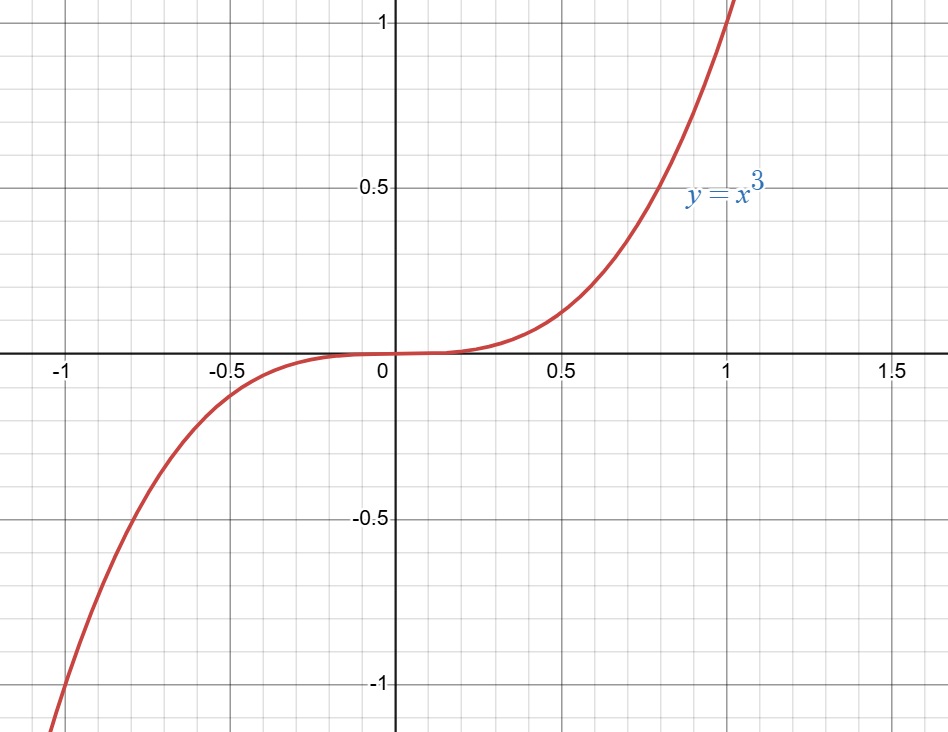
EXAMPLE: f(x) = x³ at x = 0
Step 1: f'(x) = 3x², so f'(0) = 0 ✓
Step 2: f''(x) = 6x, so f''(0) = 0 (inconclusive!)
Step 3: Use the first derivative test:
• Test x = -0.1: f'(-0.1) = 3(-0.1)² = +0.03 > 0 (positive)
• Test x = +0.1: f'(+0.1) = 3(+0.1)² = +0.03 > 0 (positive)
Conclusion: f' stays positive on both sides, so x = 0 is an inflection point (not an extremum).
Method 2: Behaviour of f ''(x) near f ''(x) = 0
If f'(a) = 0 and f''(a) = 0 then
Once you have determined f''(a) = 0, examine values around a.
• If f''(x) > 0 on both sides of x = a → concave up (minimum)
• If f''(x) < 0 on both sides of x = a → concave down (maximum)
• If f''(x) changes sign on either side of x = a → point of inflection
EXAMPLE: f(x) = x⁴ at x = 0
f'(x) = 4x³, so f'(0) = 0 ✓
f''(x) = 12x², so f''(0) = 0
Check f''(x) near x = 0:
• At x = -0.1: f''(-0.1) = 12(-0.1)² = 0.12 > 0
• At x = +0.1: f''(+0.1) = 12(+0.1)² = 0.12 > 0
Conclusion: f''(x) > 0 on both sides, so the curve is concave up near x = 0, making it a local minimum.
EXAMPLE: f(x) = x³ at x = 0
f'(x) = 3x², so f'(0) = 0 ✓
f''(x) = 6x, so f''(0) = 0
Check f''(x) near x = 0:
• At x = -0.1: f''(-0.1) = 6(-0.1) = -0.6 < 0
• At x = +0.1: f''(+0.1) = 6(+0.1) = +0.6 > 0
Conclusion: f''(x) changes sign from negative to positive, so x = 0 is a point of inflection.
Method 3: Function value around f '(a) = 0
For some value of the function at x = a, f(a), and function values close to, and around this stationary point (small h > 0):
If f(a - h) > f(a) and f(a + h) > f(a), then points around x = a are 'above' f(a) so we have a local minimum at x = a.
Similarly, if f(a - h) < f(a) and f(a + h) < f(a), then points around x = a are 'below' f(a) so we have a local maximum at x = a.
Finally, if the sign of f(a - h) - f(a) and f(a + h) - f(a) are different, then we have a (horizontal) point of inflection at x = a.
When in doubt, evaluate the function itself at points near the critical point.
This direct approach shows whether nearby values of the function are higher or lower
than the value of the function at the critical point.
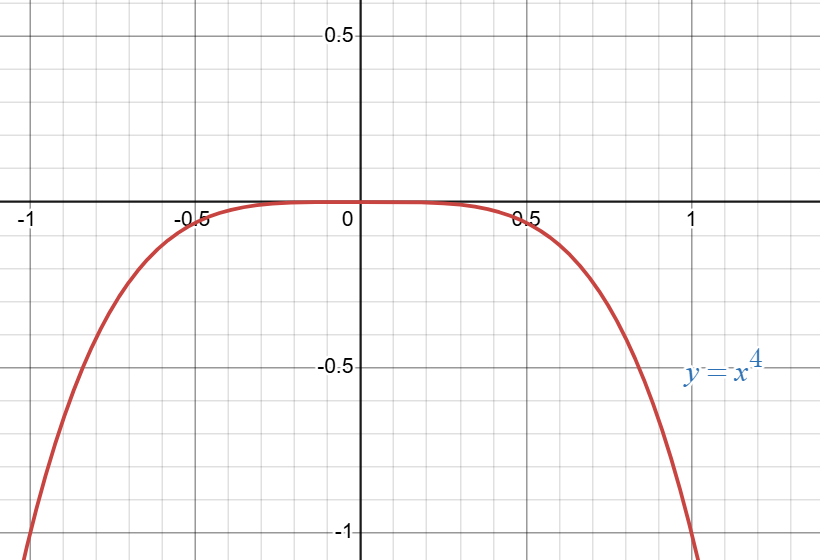
VALUES TABLE: f(x) = -x⁴
Critical point at x = 0 with f'(0) = 0 and f''(0) = 0
| x |
-0.5 |
-0.2 |
-0.1 |
0 |
0.1 |
0.2 |
0.5 |
| f(x) |
-0.0625 |
-0.0016 |
-0.0001 |
0 |
-0.0001 |
-0.0016 |
-0.0625 |
Conclusion: All nearby values are less than f(0) = 0, so x = 0 is a local maximum.
Method 4: using technology to sketch graph
Sometimes the best approach is simply to sketch the function or use graphing technology. Visual inspection can quickly reveal the nature of a critical point.
Visual Clues:
- Does the graph have a valley at x = a? → Minimum
- Does the graph have a peak at x = a? → Maximum
- Does the graph pass through x = a without turning? → Inflection point
Comparison of Methods
WHEN TO USE EACH METHOD
First Derivative Test: Best general-purpose method. Works for all functions and gives clear results. Choose this when derivatives are easy to evaluate.
Sign Chart: Best for systematic analysis and when you want to understand the complete behavior of f' around the critical point. Great for exam solutions.
Table of Values: Best when derivatives are complicated or when you want numerical confirmation. Also useful for approximate/numerical analysis.
Graphical Analysis: Best for intuition and quick checks. Use technology to visualize complex functions.
Complete Worked Example
PROBLEM: Classify the critical point of f(x) = x⁵ - 5x⁴ at x = 0
Verify it's a critical point:
f'(x) = 5x⁴ - 20x³ = 5x³(x - 4)
f'(0) = 0 ✓
Try second derivative test:
f''(x) = 20x³ - 60x²
f''(0) = 0 (inconclusive!)
Solution using First Derivative Test:
f'(x) = 5x³(x - 4)
• At x = -0.1: f'(-0.1) = 5(-0.1)³(-0.1 - 4) = 5(-0.001)(-4.1) ≈ 0.02 > 0
• At x = +0.1: f'(+0.1) = 5(+0.1)³(+0.1 - 4) = 5(+0.001)(-3.9) ≈ -0.02 < 0
Conclusion: f' changes from positive to negative, so x = 0 is a local maximum.